


The virtual assistant industry is entering a new stage of growth. As remote work expands and businesses seek flexible support, VAs are becoming a key part of modern operations. Here are the top stats and trends for 2026.
Global Growth of the Virtual Assistant Industry (2026 Trends)
The virtual assistant industry is growing at record speed, and it’s expected to expand even faster in 2026. With remote work, automation, and the need for flexible, cost-efficient support, more U.S. and global companies are turning to nearshore VAs, especially from Latin America for bilingual talent, lower costs, and higher productivity.

Key Growth Indicators:
- Remote Is the Norm: 71% of U.S. knowledge workers were projected to work hybrid or fully remote in 2023 (Gartner).
- Nearshore Demand: In North America, 43% of contact center work required a nearshore presence (PwC Global Service Study 2023).
- Global Talent Pool: Latin America, Asia, and Eastern Europe are the main sources of VA talent for U.S. companies.
The Productivity Advantage of Hiring Virtual Assistants
Businesses and entrepreneurs have noticed that hiring a VA is not just about getting tasks done, but also about working smarter and freeing up time, so they can focus on growing their operations and getting more clients.
- Productivity Boost: Remote workers, including VAs, deliver 13% higher productivity than on-site staff. (Stanford University)
- Task Delegation: Entrepreneurs regain an average of 13-15 hours per week by delegating tasks to VAs. (Virtual Assistance Institute)
- Workflow Efficiency: Companies report a 35% increase in efficiency when routine tasks are managed by VAs.
- Well-being: In a study of 7,704 employees, fully remote workers reported the highest well-being, and higher well-being was linked to lower turnover a year later (Frontiers in Psychology, via CU Boulder Today).

Financial Savings with Virtual Assistants
Hiring virtual assistants is one of the fastest-growing cost-saving strategies for businesses in 2026. Companies looking to reduce operational expenses, scale faster, and access nearshore talent are increasingly turning to VAs, especially in Latin America, where quality and affordability align.
- Cost Reduction: Global Workplace Analytics estimates U.S. employers save about $11,000 a year for each employee who works remotely half the time, thanks to higher productivity, lower office costs, and less turnover (Global Workplace Analytics).
- Affordable Talent: The median U.S. virtual assistant earns about $53K a year (Glassdoor). Latin American VAs through ThereIsTalent start at [PRECIO REAL]/month, with the same time zone and business-level English.
The Role of Technology in Virtual Assistance (2026 Outlook)
Technology continues to reshape how virtual assistants work, boosting efficiency, accuracy, and scalability. As businesses adopt AI and automation tools at record speed, VAs are becoming even more strategic and tech-driven.
- AI Integration: Over 40% of VAs now use AI-powered tools to automate tasks such as data entry, scheduling, inbox triage, and customer support, a trend expected to grow significantly in 2026.
- Cloud Collaboration: Tools like Slack, Asana, Zoom, and Notion are now standard, but tools alone don’t fix coordination. 87% of knowledge workers say they lack the time to coordinate with their teams (Atlassian, State of Teams 2026). Nearshore VAs working in your time zone close that gap.
- Specialized Software Expertise: Modern VAs work as specialists in tools like HubSpot, QuickBooks, Salesforce, and Canva. These platforms anchor a business SaaS market Omdia estimates at US$420B, growing 22.3% a year (Omdia). A VA who already knows your stack can take on revenue-generating work from day one
- Automation Adoption: Tools like Zapier and Make are taking over repetitive work. BioRender used Zapier to auto-sort billing tickets and cut resolution time by 69% (Zapier). Research shows automation reshapes roles rather than replacing them (Journal of Strategic Information Systems), so VAs can focus on decision support and system management.
Industries Benefiting Most from VAs
Companies across the U.S. are accelerating virtual assistant adoption as they search for scalable, cost-efficient support that improves productivity and customer experience in 2026 and beyond. Nearshore VAs offer operational continuity, tighter collaboration, and real-time responsiveness without the offshore friction.
-
Real Estate & Property Management: Most home buyers interview only one agent before hiring, and 80% of sellers contact just one agent (NAR 2025 Profile, via NOWBAM). The first agent to respond often wins the client. VAs keep follow-ups fast so no lead goes cold.
-
E-commerce & Online Retail: More than 60% of customers switch brands after a single bad service experience, according to Zendesk data cited by PwC (PwC). Dedicated VAs keep support fast and consistent as order volume grows..
-
Healthcare & Wellness: Administrative costs account for at least a quarter of U.S. health care spending (Duke-Margolis). A review of 29 studies found phone and text reminders cut missed appointments by about a third (PMC). VAs who manage scheduling and reminders help practices protect revenue.
- Professional Services (Law, Accounting, Consulting): Lawyers bill only 2 to 2.9 hours of an eight-hour day, depending on firm size (Clio data via LSJ). Much of the rest goes to billing, admin, and business development. VAs take that work off their plate so professionals can focus on billable work.
- Sales & Lead Generation: Harvard Business Review research found most companies respond to online leads far too slowly (HBR). VAs who own CRM follow-ups keep response times in minutes, not days.
-
Marketing & Creative Teams: 84% of marketers report high “collaboration drag” from too many meetings and unclear decisions, and teams with high drag are 37% less likely to hit revenue goals (Gartner). VAs take on scheduling, reporting, and campaign setup so marketers can focus on strategy
- Staffing & HR Operations: Filling a job takes about a month and a half on average (SHRM). VAs handle resume screening, interview scheduling, and candidate follow-ups to keep hiring moving.
-
Startups & Small Businesses: A survey of 837 U.S. microbusinesses found owners spend 22.4% of their time on admin and compliance, 79% more than on marketing and sales (UENI). VAs take on that load so founders can focus on growth.
-
Financial Services / Mortgage: In 2021, the average mortgage took 51 days to close, according to ICE Mortgage Technology data (Mortgage News Daily). VAs collect documents and keep borrowers updated so files don’t stall.
Top Regions for Virtual Assistant Services
The global virtual assistant market is evolving fast, and certain regions have become leaders thanks to their talent availability, cost-effectiveness, and strong alignment with U.S. businesses. In 2026, these regions continue to dominate the nearshore and offshore VA landscape, attracting companies looking for scalable remote support and specialized skills.
- Latin America: Countries like Colombia, Mexico, and Argentina are renowned for bilingual professionals and time zone compatibility with the U.S.
- Asia: The Philippines and India dominate the VA market, offering specialized skills at competitive rates.
- Eastern Europe: Nations like Poland and Ukraine are popular for tech-savvy VAs with expertise in IT and software development.
Industry Expertise
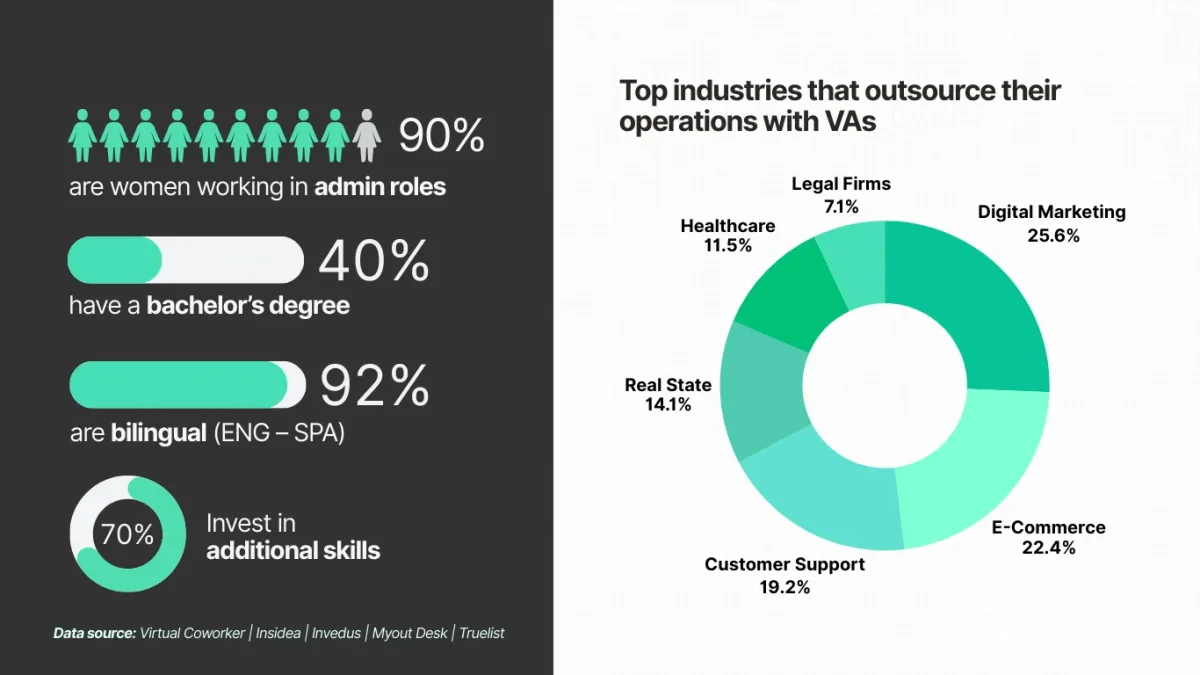
Virtual assistants now go far beyond admin work; they’re specialists. Today, marketing agencies, e-commerce brands, and customer support teams rely on VAs for key operations. Real estate, healthcare, and legal teams also delegate core tasks, from property listings to scheduling and research. With nearly half of VAs specializing in niche roles, hiring a VA gives businesses access to skills that would normally require an entire department.
The Earnings of Virtual Assistants
VA salaries vary significantly depending on location, expertise, and client needs:
- U.S.-Based VAs: The median U.S. virtual assistant earns about $53K a year, with most earning between $42K and $66K (Glassdoor).
- Latin American VAs: Rates through ThereIsTalent range from $1,999 to $2,199/month, with U.S. time zone overlap and business-level English.
- Asian VAs: Often the lowest-cost option, but large time zone gaps make real-time collaboration with U.S. teams harder.
Latin American VAs: The Nearshore Advantage
For U.S.-based businesses, hiring VAs from Latin America offers several key advantages. Shared time zones make communication faster and more efficient, while strong cultural alignment improves collaboration and customer experience. Additionally, with 92% of LATAM VAs being bilingual, companies benefit from seamless English communication in daily operations and client-facing tasks.
| Factor | LATAM Virtual Assistants | Asia-based VAs | U.S. In-house Staff |
|---|---|---|---|
| Time-zone alignment | ✔ Same/near U.S. business hours | ✖ Diferencia de 10–13 h | ✔ Total alignment |
| English proficiency | ✔ High bilingual rates | ✔ Variable | ✔ Native |
| Average cost | $400–$2,000/month | $5–$12/hour | $50,000–$70,000/year |
| Ease of communication | ✔ Cultural + communication affinity | ✖ Usually lower | ✔ High |
| Recruitment & onboarding speed | ✔ Fast, flexible & scalable | ✔ Moderate | ✖ Slow / costly |
| Training burden | Low-medium | Medium-high | High |
| CX + client-facing suitability | ✔ Very strong | Moderate | ✔ Strong |
| Shared holidays/work calendar | ✔ Mostly aligned | ✖ Not aligned | ✔ Fully aligned |
Future Trends in the VA Industry
The VA industry is expected to keep growing in the coming years, driven by AI innovations and platforms that enhance communication:
- Niche Specialization: More VAs are moving beyond general admin work into specialized areas like bookkeeping, marketing, and CRM management.
- Hybrid Roles: VAs will increasingly integrate AI tools into their workflows, improving efficiency and accuracy.
- Remote Work Expansion: A survey of 1,000+ U.S. hiring managers projected that 73% of all departments will have remote workers by 2028 (Upwork).
These trends make one thing clear: remote work isn’t slowing down, it’s maturing. Companies that adapt early will benefit from stronger talent pipelines, better team performance, and greater operational flexibility. As we move forward, the question isn’t if businesses should hire remotely, but how they’ll build remote teams that truly drive results. Let’s close with what today’s leaders must consider to prepare for the future of hiring.
Why Now Is the Time to Hire a VA
The data speaks for itself: virtual assistants are transforming businesses by boosting productivity, cutting costs, and enabling entrepreneurs to focus on growth. Whether you’re a startup or a seasoned business owner, leveraging the power of VAs can help you stay competitive in today’s fast-paced market.

Ready to find the perfect VA? Schedule a free consultation with There is Talent today and access top candidates from Latin America to support your business needs.


